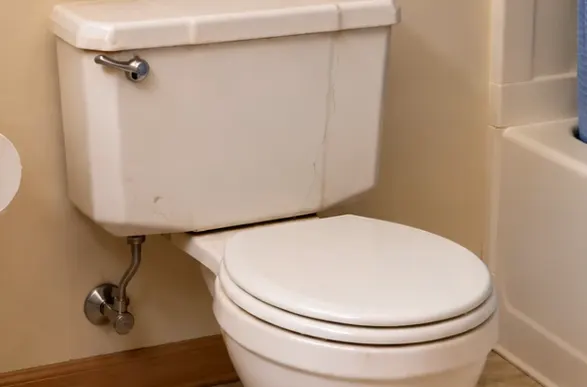
Fountain Valley water is hard. The City of Fountain Valley water quality report puts average hardness at about 195 parts per million, roughly 11 grains per gallon. That is the mineral content, mostly calcium and magnesium, carried in every gallon. You see it as white crust on taps and kettles. Inside a toilet, the same minerals work slowly and out of sight, and after enough years they change how the toilet flushes, fills and seals. This page goes part by part.
The city figures behind this page are on Fountain Valley Water Facts
The rim jets: where weak flushes are born
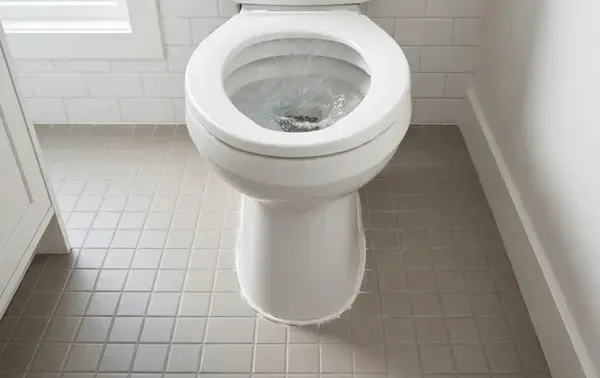
Under the rim of the bowl sit the rim jets, a ring of small angled holes. At each flush they send water swirling around the bowl. That swirl is half the flush. Hard water scale grows inside those small holes year by year, a fraction at a time. The holes narrow. The swirl weakens. The water level rises, turns slowly, and drains without force.
The result is the classic local complaint: the toilet is not blocked, the tank parts are fine, and the flush is still weak. Homeowners plunge and plunge a toilet that has no clog. In Fountain Valley, a weak flush is often a water problem before it is a toilet problem. The siphon jet, the larger hole low in the bowl that starts the siphon, scales up in the same way and costs the flush its pull.
What helps: the jets can be cleared. A technician clears each rim jet by hand with a small pick or wire, or by reaming, and clears the siphon jet the same way. It is slow, careful work, and on badly scaled bowls it brings back a flush the owner thought was gone for good.
The fill valve: scale inside the works
How hard is Fountain Valley water?
About 195 parts per million, roughly 11 grains per gallon, per the City of Fountain Valley water quality report. That counts as hard to very hard.
Can hard water cause a weak flush?
Yes, and here it often does. Scale narrows the rim jets that give the flush its swirl and the siphon jet that gives it pull. The toilet has no blockage. The jets are closing up.
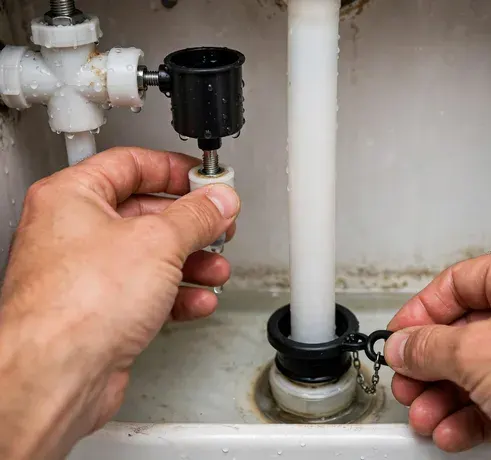
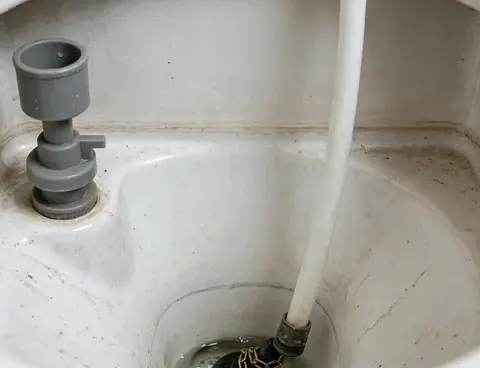
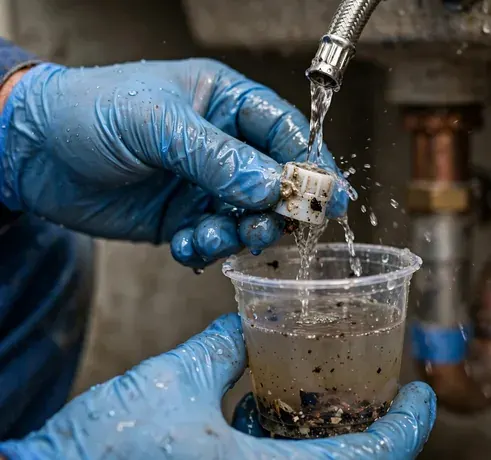
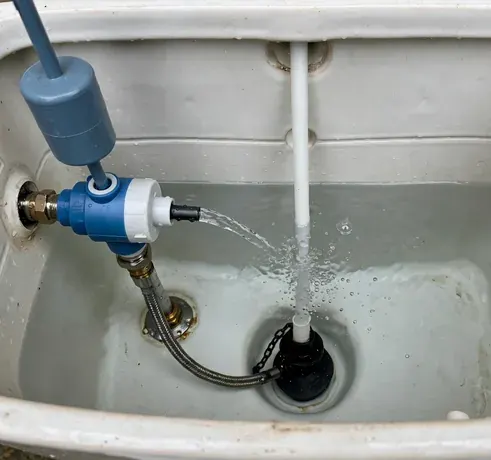
A fill valve is a small water gate with moving seals. Scale coats its inside walls and the float gear. Pro repair videos of valve swaps in hard water areas show old valves coming out of tanks crusted in deposits, still working after a fashion, but slow and unreliable. In daily life that reads as:
- The tank takes longer and longer to refill
- The valve hisses after the tank should be full
- The valve sticks, then frees, then sticks again
- The tank level wanders, so the flush varies day to day
What helps: a scaled valve is usually replaced, not scrubbed. The valve is a wear part, and local scale is the reason local valves have a working life. When a new valve goes in, its height is set by the overflow tube measurement, because a valve set too tall overfills into the overflow tube and wastes the water the swap was meant to save. Fill valve detail: Toilet Fill Valve Guide
The flapper: rubber that stops being rubber
A flapper seals because it is soft. Hard water minerals and the chemicals in treated water harden that rubber over time. The flapper loses its deep colour and turns pale, its sealing face warps, and it starts to pass water in a slow leak you cannot see. The toilet phantom flushes to top the tank up. At about 200 leaked gallons a day, that small leak is roughly $35 a month at the city rate of $4.36 per HCF.
Drop-in tank cleaning tablets make this worse, because they keep chlorine sitting against the flapper all day. A chlorine-resistant flapper lasts longer in a tank that uses them.
What helps: the leak is proved first with a dye test, colour in the tank and ten minutes to show in the bowl, then the right size flapper goes in with the chain set at one link of slack. Flapper detail: Toilet Flapper Guide
The tank and bowl: build-up you can see
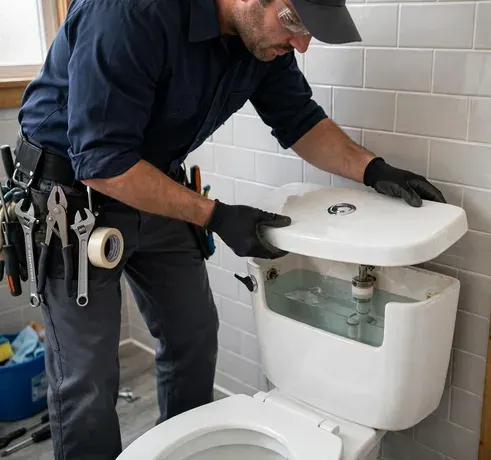
Scale lines the tank walls and gathers around the flush valve seat. A rough flush valve seat is a quiet problem: no new flapper can seal against a pitted seat, so owners replace flapper after flapper and the running comes back. In the bowl, mineral stains mark the water line and the jet holes, and heavy build-up in the trapway roughens the passage that waste has to clear. Bleach in the tank is not the answer. It attacks gaskets and plastic parts and trades a stain problem for a leak problem.
What about a water softener?
A whole-home softener reduces hardness for the whole house, toilets included, and softened water slows all of the above. That is as far as honest advice goes here: softeners are a home-level purchase with their own costs and upkeep, they are not a toilet part, and we do not sell them. If your home already has one, your toilet parts will still wear, just more slowly. If it does not, the practical path is the local one: jets kept clear, wear parts replaced on time, and parts judged by test results rather than by age.
How a hard-water toilet is checked
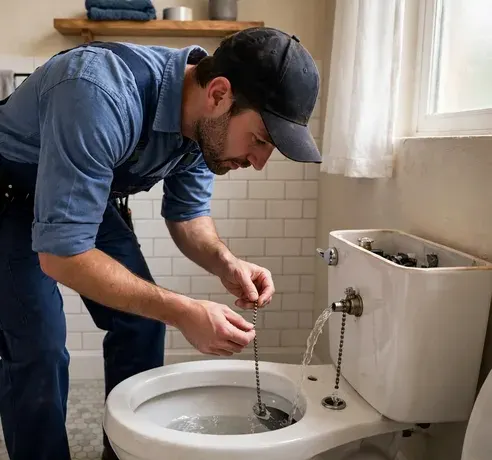
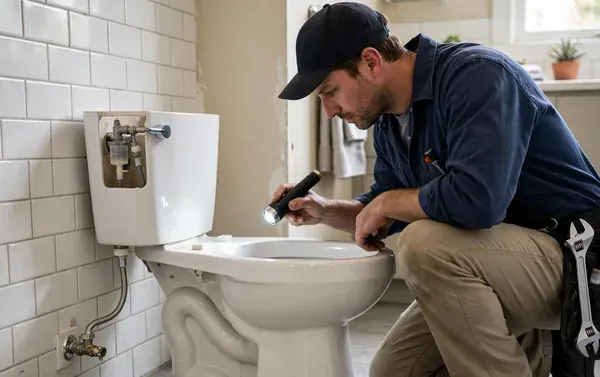
A technician works through a hard-water toilet in a set order. First the tank is dye tested, because a leaking flapper is the cheapest fault and the most common. Then a flush is watched: a weak swirl with a full tank points at the rim jets and the siphon jet, not a clog. The refill is timed, because slow filling points at the fill valve or sediment in it. Where a flapper has been changed and the running persists, the flush valve seat is checked by feel for pitting. And the tank as a whole is read: heavy scale on every part says the tank is due a rebuild, not one more single part.
If the checks point under the toilet, at a flange, or at a floor, that is past water-and-parts work. Call Toilet Repair Fountain Valley at +1 (657) 359-9352 and describe the symptoms. Open 24/7.
Related pages
Frequently asked questions
Why do my flappers wear out fast?
Minerals harden the rubber and treated water adds to the wear. Drop-in cleaning tablets steep the flapper in chlorine and shorten its life further. A chlorine-resistant flapper is the better fit if you use them.
Does hard water raise my water bill?
It can, by way of the parts it wears out. A flapper leak caused by hardened rubber can waste about 200 gallons a day, roughly $35 a month at local rates. The scale itself does not change the rate; the leaks it causes change the usage.
Can scaled rim jets be cleaned, or do I need a new toilet?
They can be cleared by hand, jet by jet, and the siphon jet too. Owners are often surprised how much flush comes back. A new toilet is the answer when the porcelain is cracked or the trapway itself is rough and narrowed beyond clearing.