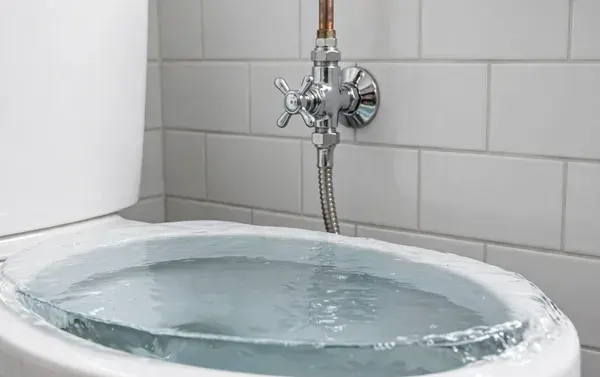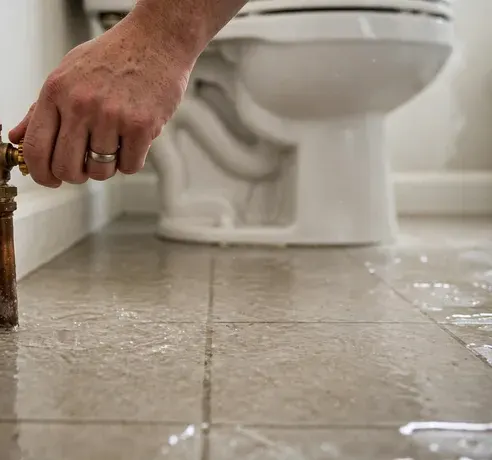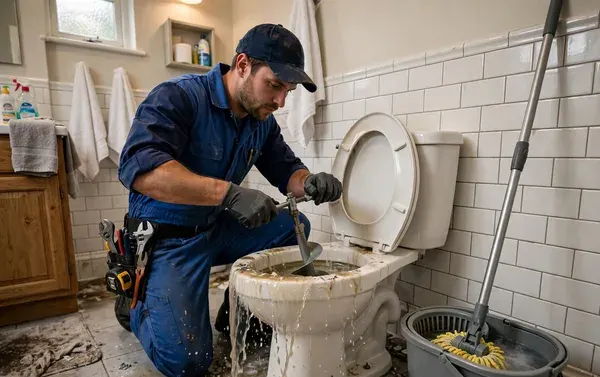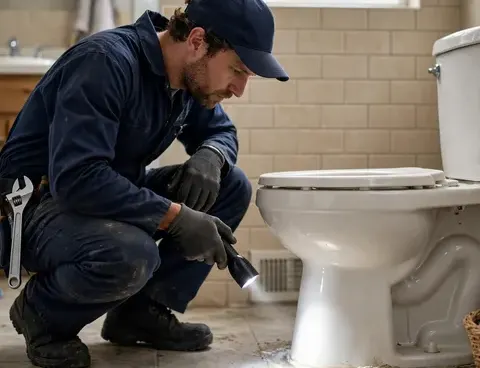
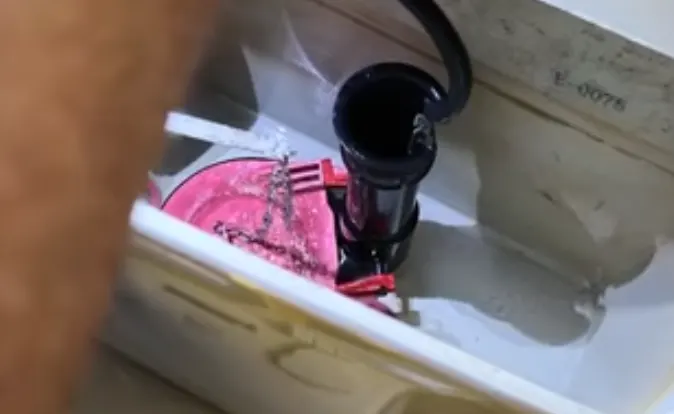
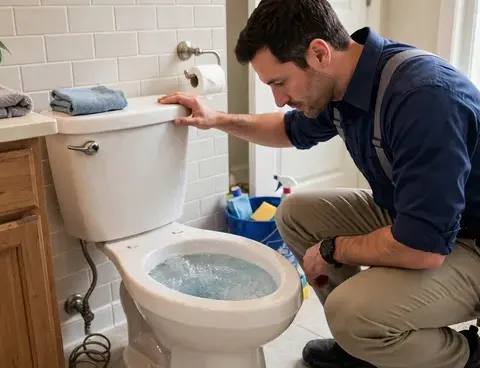
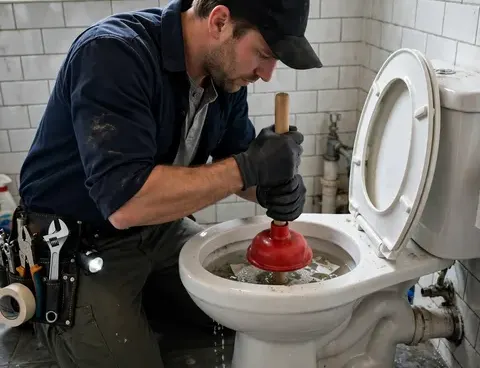
The fill valve is the tall unit standing in the left of the tank. Every sound your toilet makes after a flush comes from it or from the flapper it works beside. It controls how fast the tank refills, where the water stops, and how much water goes back into the bowl. When it wears out, the symptoms are slow filling, a tank that never quite fills, hissing, whistling, or water that runs down the overflow tube and never stops.
How a fill valve works
- You flush. The tank empties and the float on the fill valve drops with the water.
- The drop opens the valve. Water comes up the supply line, through the valve, and into the tank.
- A refill tube clipped to the overflow tube sends some of that water into the bowl to bring the bowl back to its proper level.
- The float rises with the tank water. At the set level, the float shuts the valve. The toilet sits full and quiet.
That is the whole cycle. Every fill valve fault is a fault in one of those four steps.
Float types you will meet
How do I know if my fill valve is bad?
Slow filling, hissing after the tank is full, whistling during the fill, or a tank that overfills into the overflow tube. If the angle stop is open, the supply line is sound, and the tank still will not fill or will not stop, the valve is the fault.
What should the water level in the tank be?
About half an inch to one inch below the top of the overflow tube, or at the fill line marked by the maker. Higher than that and water runs down the overflow tube all day. Lower and the flush is weak.
- Float cup. A cup that slides up and down the valve body. The most common type on modern universal valves. The level is set by sliding the cup on its clip.
- Ballcock with float ball. An arm with a ball on the end, found on older toilets. The arm bends or screws to set the level. This is the fitting the old supply line size, 3/8 inch by 7/8 inch ballcock, is named after.
- Internal float. The float hides inside the valve body. Nothing shows in the tank but the cap. Setting is by a screw or dial on the valve.
Hard water is hard on fill valves
Fountain Valley water runs about 195 parts per million hardness, roughly 11 grains per gallon, per the City of Fountain Valley water quality report. Mineral scale builds up inside a fill valve year by year. Pro repair videos show old valves pulled out of tanks coated in deposits, and that coat is why a valve that worked for a decade starts to fill slowly, stick, or refuse to shut off. Sediment from the supply line collects in the valve too, and a partly blocked valve is a slow tank. More on what local water does to toilets: Hard Water and Your Toilet
The whistle, and what it means
A fill valve that whistles or sings while the tank fills has a worn diaphragm inside the valve head. The diaphragm no longer opens fully, so water squeezes past it at speed and vibrates. That whistle is a wear warning, not a quirk. A whistling valve is on its way to sticking open or shut, and the answer is a new valve, not an adjustment.
Other failure signs:
- Tank fills much more slowly than it used to
- Hissing that never quite stops after the tank is full
- Water trickling down the overflow tube (level set too high, or the valve will not close)
- Tank does not fill at all, and the angle stop is open and the flapper is seated
Height is set by the overflow tube
This is the measurement that decides if a new valve works in the tank it serves. The height is taken from the floor of the tank to the top of the overflow tube. In the pro example our research uses, that measurement was 8 and 3/4 inches. The new valve is set to that height before it is fitted: universal valves twist or unclip to lengthen and shorten, and the valve body is matched to the measurement so the float can shut the water off below the top of the overflow tube.
The fitting itself is hand tight on the valve's plastic nut, then about a quarter turn more with channel-lock pliers. Plastic threads cross-thread easily, and a nut that goes on wrong leaks from the first fill. The refill tube clips to the overflow tube with a gap at the top: that gap is an air gap, and it stops tank water, which may hold cleaning chemicals, from siphoning back into the house water supply. With the water back on, the level is set by the float adjustment, not by the house water pressure. The water should stop about half an inch to an inch below the top of the overflow tube, or right at the fill line marked on the tube or tank.
The Fluidmaster 400A is the common universal valve found in most kits, and its pattern is the one most fittings follow. Other makes set the same way in principle: height first, level second.
What a valve swap involves
A fill valve swap is tank-in-place work: water off at the angle stop, tank drained, supply line undone, the valve nut freed from below the tank, the old valve out, the new valve in at the measured height, the line back on without cross-threading, then the level set and several test flushes run. The supply line is often replaced at the same time if it is old. Its rubber seals are one-time seals, and a disturbed old line is a common source of the next leak.
One fault stops the job before it starts: an angle stop that will not shut the water off fully. That valve has to be sorted before the fill valve comes out. If you reach that point, or the noise and slow fill point to scale damage deeper in the system, call Toilet Repair Fountain Valley at +1 (657) 359-9352. Open 24/7. Background reading: Toilet Parts and Repair Kits
Related pages
Frequently asked questions
Can hard water really damage a fill valve?
Yes. Mineral scale coats the inside of the valve and the float gear. In Fountain Valley, with water at about 195 ppm hardness, that build-up is a normal cause of slow fills and valves that stick with age.
Is a fill valve swap a one-person job?
It is a one-technician job, with the work done from above and below the tank and the toilet in place. The two points that catch people out are cross-threaded plastic nuts and a seized angle stop. Both are handled slowly.
Why does my tank take so long to refill?
Common causes, in order: the angle stop is not fully open, sediment is partly blocking the fill valve, the valve is scaled up from hard water, or the refill flow knob on the valve is set low. A technician works through them in that order.