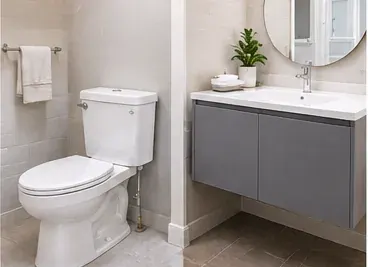
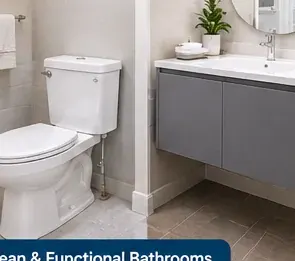
A wall-hung toilet floats. The bowl mounts to the wall with clear floor beneath it, and everything that makes it work, the tank, the frame, and the drain connection, lives inside the wall cavity behind the tiles. In Fountain Valley they appear in modern remodels, in small bathrooms where every inch is argued over, and in some commercial restrooms. They are a genuinely different machine from the floor-standing toilet, and the difference that matters most is not how they look. It is how they are reached when something goes wrong.
How it is built
Inside the wall sits a steel carrier frame, bolted to the structure of the house. The frame carries the bowl's weight, holds a concealed tank, and routes the drain out through the wall or down through the floor. The flush is worked by a wide plate on the wall, often with two buttons for a light and a full flush, and that plate is also the door to the machine: it removes to give access to the flush mechanism and the fill valve inside.
Nothing under a wall-hung toilet touches the floor. There is no base, no wax ring at the floor in the usual sense, and no toilet rocking on a flange. The seal that matters is at the wall, where the bowl connects to the drain outlet of the carrier, and it lives out of sight from the day the wall is closed.
The space and cleaning case
Can a wall-hung toilet hold an adult's weight?
Yes. The bowl hangs from a steel carrier frame fixed to the structure of the house, and the system is engineered for full adult use. The porcelain floating is a look, not a compromise.
How does a technician reach the parts?
Through the flush plate on the wall, which removes to open an access window into the concealed tank. Valves and flush mechanisms are serviced through that opening, with parts matched to the carrier brand and model.
The reason people choose this design is honest. Moving the tank into the wall takes the toilet's depth off the room, which in a small bathroom can be the difference between a door that swings freely and one that does not. The clear floor beneath the bowl makes cleaning simpler than under and behind any floor-standing toilet, where dust gathers in the one place a mop cannot reach. Those advantages are real, and in a tight Fountain Valley bathroom, in homes whose median build year is 1972 and whose bathrooms were drawn small, they can be the deciding ones.
Why repair access differs
Every working part of a wall-hung toilet is reached through the flush plate opening. A technician's hands and tools work through that window, which is smaller than an open tank. Fill valves, flush mechanisms, and seals for these systems are brand and carrier specific, made by the firms that build the in-wall systems, and they are matched to the carrier model as strictly as any part in plumbing. A running wall-hung toilet is therefore an identification job first, like a TOTO or a Kohler canister tank, only more so.
The hidden plumbing cuts the other way too. On a floor-standing toilet, most leaks eventually show themselves: a damp base, a stain, a smell. Behind a wall, a slow leak at the bowl's drain connection or a weeping supply fitting can wet the inside of the wall cavity for a long time before any sign reaches the room. The signs that do appear are indirect: a musty smell near the wall, paint or tile that changes, a flush that weakens as the mechanism wears, water sounds that continue after the flush should have ended. Any of those on a wall-hung toilet deserves a prompt look rather than a patient one, because the cost of the fault grows in the dark.
What repair usually involves
The common faults are the common toilet faults wearing different clothes: a fill valve that will not shut cleanly, a flush mechanism seal that lets the concealed tank seep, buttons or a flush plate that stop working smoothly. A running in-wall tank wastes water at the usual rate, around 200 gallons a day, roughly $35 a month at Fountain Valley's $4.36 per HCF, and it is heard more often than seen, as a faint refill sound from inside the wall. Work through the access panel covers most of these. The faults that do not fit through the panel, a failed connection at the wall or damage to the carrier itself, are the uncommon and serious end of this design's repair range, and a technician will be plain about which kind of fault yours is before any wall is opened.
Installation and replacement of wall-hung units, and what the carrier work involves, are covered on New Toilet Installation and Replacement in Fountain Valley. For comparison with the floor-standing designs most homes use, see One-Piece vs Two-Piece Toilets, and for toilets that add powered features to the bowl, see Smart Toilets and Smart Seats.
The honest summary
A wall-hung toilet is a good design with a specific price: when it needs attention, the attention is more specialized, the parts are matched to the carrier, and hidden faults reward early checking. Owners who know that get the best of the design. Owners who treat it like a floor toilet with prettier lines are the ones surprised by it.
If your wall-hung toilet runs, leaks, smells musty at the wall, or flushes weakly, call Toilet Repair Fountain Valley at +1 (657) 359-9352. Open 24/7, and the price is confirmed before any work begins.
Related pages
Frequently asked questions
What are the warning signs of a hidden leak?
A musty smell at the wall, discoloration or softness in paint or tile near the toilet, the sound of refilling long after a flush, and a steadily weaker flush. On this design, hidden leaks can run a long time, so signs are worth acting on early.
Is a wall-hung toilet harder to repair than a normal toilet?
The faults are similar but access is tighter and parts are carrier-specific, so the work is more specialized. Most tank faults are handled through the access panel without opening the wall.
Can I replace a floor toilet with a wall-hung one?
It is a bigger job than a like-for-like swap, because the carrier frame, concealed tank, and drain route all go inside the wall. It is normally done as part of a bathroom remodel rather than as a standalone replacement.